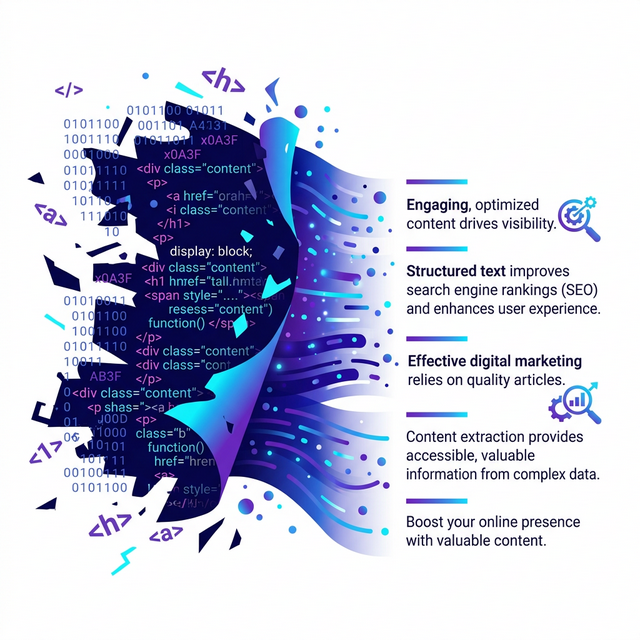
If you were to peek behind the curtain of a modern webpage, you would likely see thousands of lines of messy `<div>` tags, inline CSS, heavy JavaScript libraries, and tracking scripts. To human eyes, the page might look like a beautiful, minimalist article. But to a search engine bot, it looks like a labyrinth of code.
One metric that SEOs have debated for decades is the HTML-to-Text Ratio. Today, we are breaking down exactly what this means, how search engines process it, and why extracting pure text is essential for your content strategy.
What is the HTML-to-Text Ratio?
Simply put, this ratio calculates the percentage of actual readable text on a webpage compared to the amount of HTML code required to display it. For example, if a page contains 100,000 bytes of HTML code, but only 10,000 bytes of actual paragraph text, the HTML-to-Text ratio is 10%.
Is it a Direct Google Ranking Factor?
Let's clear the air: John Mueller and other Google representatives have stated multiple times that Google does not use HTML-to-Text ratio as a direct ranking signal. A page with a 5% ratio will not be algorithmically penalized simply for having a low percentage.
However, an abnormally low ratio is almost always a symptom of a much deeper technical SEO disease.
The Hidden Dangers of Code Bloat
1. Crawl Budget Exhaustion
Search engines allocate a specific "Crawl Budget" to every website—a limited amount of time and resources they are willing to spend crawling your pages. If your server is sending 5 megabytes of bloated HTML code for a 300-word article, Googlebot will waste its budget parsing useless DOM elements instead of discovering your new posts.
2. Text Obfuscation and NLP Confusion
Search engines use Natural Language Processing (NLP) to understand the semantic meaning of your content. To do this, they must first strip away all HTML, CSS, and JS to extract the raw text (you can simulate this using our Pure Text Extractor tool). If your text is hidden behind complex DOM structures, loaded dynamically via client-side JavaScript, or fragmented across dozens of nested <span> tags, the NLP algorithm might struggle to stitch the sentences together logically.
3. Page Load Speed
More code equals longer load times. Longer load times destroy your Core Web Vitals, resulting in higher bounce rates and, eventually, lower rankings.
How to Analyze Your Content Like a Bot
To truly understand how Google sees your webpage, you must view it without the visual styling. Using a Content Extraction Tool allows you to instantly strip away the noise. When you look at the raw text dump:
- Is your primary content actually visible, or did it get stripped away because it was loaded via a hidden script?
- How much "boilerplate" text (navigation menus, footer links, sidebar ads) is diluting the unique article content?
- Are your headings structured logically when read as a plain text document?
Conclusion
While you should not obsess over hitting an arbitrary "20% text ratio" metric, you must aggressively protect the accessibility of your content. By writing clean, semantic HTML and testing your pages using a text extractor, you ensure that search engines spend their time analyzing the brilliance of your writing, rather than battling through a jungle of code.