Imagine you write an article and the word "Apple" appears 10 times. How does a search engine know if your article is about the technology company that makes iPhones, or the red fruit you bake into a pie?
The answer lies in the surrounding vocabulary. If the article also contains words like "orchard," "harvest," "cider," and "crisp," the search engine understands the context. If it contains words like "iPhone," "MacOS," "Tim Cook," and "silicon," the context shifts entirely.
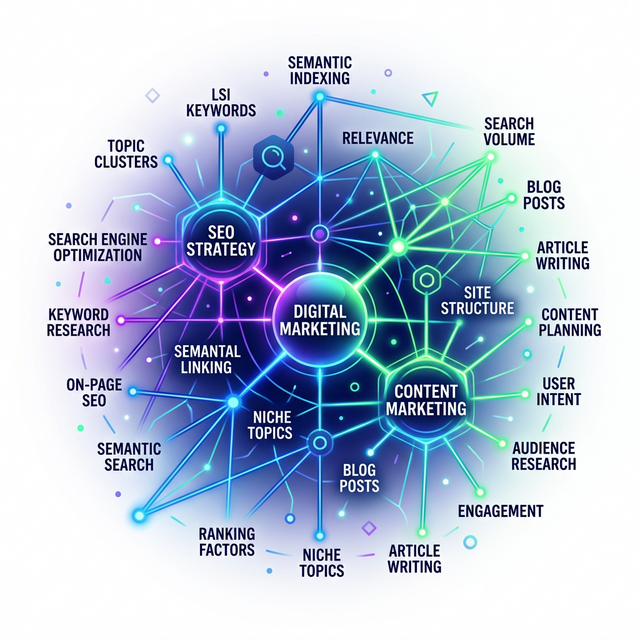
These context-proving words are what the SEO industry refers to as LSI (Latent Semantic Indexing) Keywords.
What Are LSI Keywords?
Technically speaking, Google claims they do not use the specific "LSI" algorithm (which is a patented technology from the 1980s). However, they absolutely use Semantic Search and Entity Association. We use the term "LSI keywords" colloquially to describe conceptually related terms, variations, and sub-topics that naturally orbit a primary keyword.
Why Semantic Search Changed Everything
In the past, to rank for "best DSLR cameras," you had to use that exact phrase repeatedly. Today, Google's neural matching systems understand concepts. An article titled "Top Digital Single-Lens Reflex Cameras for Photography" can easily rank for "best DSLR cameras" even if the exact exact-match phrase never appears on the page.
By including a deep bench of LSI keywords, you signal to Google that your content has incredible depth and topical comprehensiveness. You transition from answering a simple text query to becoming an authoritative hub of knowledge on an "Entity."
How to Find and Implement LSI Keywords
1. The "Searches Related To" Method
The easiest way to find LSI terms is directly from Google. Search your primary keyword, then scroll to the very bottom of the results page to the "Related Searches" box. These are terms Google inherently associates with your topic.
2. Use a Keyword Density Checker on Competitors
Find the article currently ranking #1 for your target keyword. Copy their text and paste it into our Keyword Density Checker. Look past their primary keyword and examine their top 2-word and 3-word phrases. You will uncover the semantic vocabulary they used to win the top spot, which you can then incorporate into your own outline.
3. Answer the "People Also Ask" Questions
The accordion boxes in the middle of a Google search (People Also Ask) represent the direct logical follow-up questions users have. By turning these questions into H2 or H3 subheadings in your article, you naturally inject highly relevant semantic variations into your text.
Conclusion
SEO is no longer a game of matching strings of characters; it is a game of matching concepts. By shifting your focus away from exact-match keyword stuffing and toward rich, topical, LSI-driven ecosystems, you future-proof your website against algorithm updates and provide a vastly superior experience for your readers.