Websites evolve. You change your domain name, you upgrade your CMS, you transition from HTTP to HTTPS, or you consolidate old blog posts. In all of these scenarios, the 301 Permanent Redirect is your best friend, safely guiding users and search engines from the old URL to the new one.
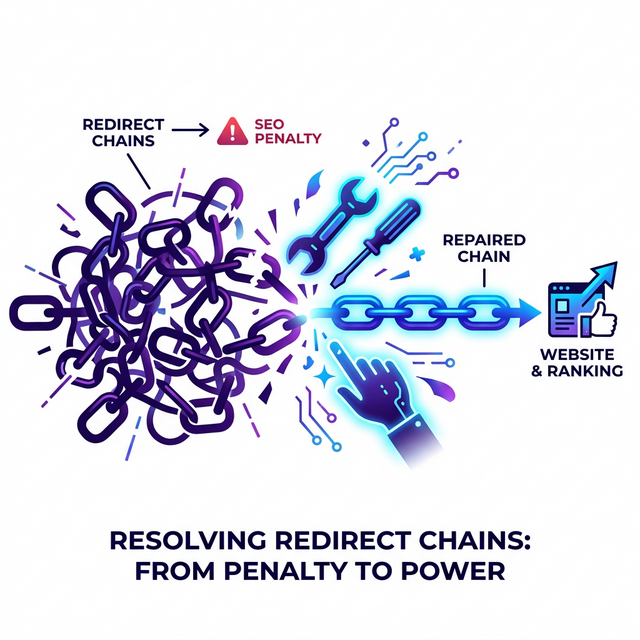
However, when standard redirects are mismanaged over years of website evolution, they morph into an SEO nightmare known as a Redirect Chain.
What is a Redirect Chain?
A chain occurs when there is more than one redirect between the initial URL requested and the final destination URL.
For example: A user types in http://yoursite.com/about.
- The server redirects them to the secure version:
https://yoursite.com/about(Redirect 1) - That URL was changed last year, so it redirects to:
https://yoursite.com/about-us(Redirect 2) - Last month, you launched a new design, so it redirects to:
https://yoursite.com/company/about(Redirect 3)
To reach the final page, the browser had to jump through 3 separate hoops.
Why Chains Destroy Your SEO
1. Massive Page Speed Delays
Every single "hop" in a redirect chain requires an entirely new HTTP request to the server. If your server takes 300 milliseconds to process a request, a chain of 4 redirects will force the user to stare at a blank white screen for 1.2 seconds before the final page even begins to load. This will nuke your Core Web Vital scores and skyrocket your bounce rate.
2. Loss of Link Equity (Juice)
Historically, Google diminished PageRank (link equity) by roughly 10-15% with every 301 hop. While Google claims this dilution no longer occurs, rigorous SEO testing suggests that massive chains still result in a severe devaluation of the original backlink. If Forbes linked to your Page A, but it takes 6 hops to get to Page Z, Page Z is receiving almost zero ranking power.
3. The Crawl Budget Trap & Loops
Googlebot will only follow a chain for roughly 5 hops before giving up entirely. If your important pages are buried behind a massive chain, Google will literally refuse to index them.
Worse, if Page A points to Page B, and a misconfiguration causes Page B to point back to Page A, you have created an Infinite Redirect Loop. The website will crash, displaying an `ERR_TOO_MANY_REDIRECTS` error.
How to Audit Your Redirects
You cannot see a redirect chain in your browser because it happens too fast. To visualize the hops, you must use a Redirect Chain Checker tool.
Input your most important legacy URLs, your HTTP versions, and your non-www versions into the tool. The checker will output the exact HTTP status codes (301, 302, 200) and trace the exact path the server is taking.
The Solution
Fixing a chain is incredibly simple once you map it out. You simply change the very first URL in the chain to point directly to the final URL, cutting out all the middle-men. One hop. Perfect speed.